
Table of Contents
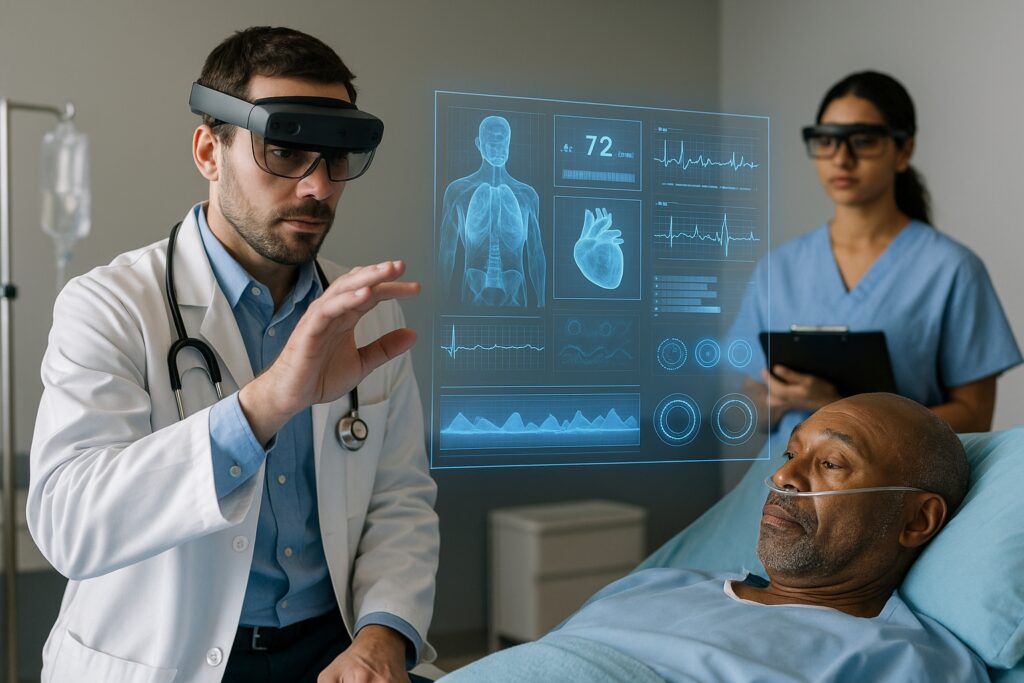
ToggleImagine a world where doctors don’t just rely on their trusty stethoscopes but also don high-tech goggles that overlay vital patient information right before their eyes. Welcome to the fascinating realm of augmented reality in healthcare. This cutting-edge technology is transforming how medical professionals diagnose, treat, and even educate, making healthcare not only more efficient but also a bit more futuristic—think of it as the superhero of the medical field.
Overview of Augmented Reality for Healthcare
Augmented reality (AR) revolutionizes healthcare by blending digital information with the real world, enhancing medical practices significantly. This technology facilitates improved visualization of complex anatomical structures, enabling surgeons to navigate with precision during procedures. Doctors utilize AR systems to superimpose images from MRIs or CT scans directly onto a patient’s body, making the diagnosis and treatment more accurate.
Training medical professionals benefits greatly from augmented reality. Students immerse themselves in lifelike simulations, mastering techniques without risk to patients. AR fosters interactive learning, enhancing retention of information through practical application.
Patient education receives enhancement through augmented reality. Individuals engage with 3D models of their conditions, allowing them to comprehend their medical issues better. Enhanced understanding often leads to increased satisfaction and adherence to treatment plans.
Clinical efficiency improves as healthcare professionals employ AR to streamline workflows. Relevant data, such as patient records or lab results, appear in real-time during consultations. Such immediate access promotes informed decision-making and reduces the likelihood of errors.
Development of augmented reality applications specifically tailored for healthcare continues. Companies invest in creating solutions that engage both patients and practitioners, driving overall benefits. Integration of AR in telemedicine emerges too, bridging gaps between patients and healthcare providers regardless of location.
Future advancements in augmented reality will likely introduce even more sophisticated applications within healthcare. These innovations may lead to increased diagnostics accuracy and enhanced surgical outcomes, fundamentally reshaping patient care.
Benefits of Augmented Reality in Healthcare
Augmented Reality significantly enhances various aspects of healthcare. Key advantages include improved patient engagement and surgical accuracy.
Enhanced Patient Engagement
Patients experience better involvement in their healthcare through Augmented Reality. They can visualize their medical conditions in 3D, allowing for a more thorough understanding of treatments. Interactive models facilitate discussions between patients and healthcare providers. Engaging with AR content helps individuals remember information and adhere to treatment plans. Satisfaction increases when patients grasp the complexities of their health issues in an accessible format. Practitioners also benefit from enhanced communication, which fosters stronger relationships with their patients.
Improved Surgical Accuracy
Surgeons achieve higher precision during procedures using Augmented Reality technology. By overlaying critical imaging data onto a surgical field, they navigate anatomical structures with greater clarity. Access to real-time information reduces the likelihood of errors. Detailed visuals enable quick decision-making and enhance operative performance. Surgeons gain confidence in their techniques when they utilize AR tools. Each procedure becomes more predictable, leading to improved patient outcomes. Investments in AR applications continually evolve, providing healthcare professionals with essential tools to refine their skills in high-stakes environments.
Applications of Augmented Reality in Healthcare
Augmented reality transforms healthcare through various applications. This technology plays a crucial role in enhancing medical training, patient care, and rehabilitation.
Medical Training and Education
Medical training benefits significantly from augmented reality. Students engage with lifelike simulations that mimic real-life scenarios. They can practice complex procedures without risk to real patients. Using AR, trainees visualize anatomy in 3D, which reinforces their understanding. Educators use these tools to enhance lessons, making complex concepts more accessible. Institutions report improved knowledge retention among students. Interactive learning through AR fosters confidence, enabling future healthcare professionals to excel in their practice.
Patient Care and Rehabilitation
Patient care sees remarkable improvements through augmented reality applications. Individuals can visualize their medical conditions using 3D models, promoting better understanding. AR enhances the rehabilitation process by offering guided exercises that patients can follow in real-time. Physical therapists utilize AR to monitor patient progress and provide immediate feedback. Reports indicate that patients exhibit higher motivation through interactive technology. Enhanced engagement leads to improved adherence to treatment plans, resulting in better outcomes.
Challenges and Limitations
Augmented reality (AR) in healthcare faces several challenges and limitations that affect its implementation. Technical constraints and acceptance among healthcare professionals hinder widespread adoption.
Technical Constraints
Limited bandwidth and high processing demands can complicate the deployment of AR systems. Device compatibility issues arise, as not all technologies integrate seamlessly with existing healthcare infrastructure. Inconsistent data accuracy may affect the reliability of AR applications, potentially leading to misdiagnoses or flawed surgical guidance. Moreover, the need for specialized hardware can increase costs, making it less accessible to many healthcare facilities. These factors can impact the effectiveness and reliability of AR tools in everyday medical practice.
Acceptance Among Healthcare Professionals
Not all healthcare professionals readily embrace AR technology. Some express skepticism about its efficacy, questioning the overall value it brings to patient care. Concerns about training requirements also arise, as professionals may feel unprepared to adapt to new systems. Resistance to change can slow the adoption process. Additionally, many professionals require convincing evidence of AR’s benefits in real clinical environments. Gaining widespread acceptance within the medical community remains a crucial hurdle that influences AR technology’s future in healthcare.
Future Trends in Augmented Reality for Healthcare
Emerging trends in augmented reality (AR) showcase its profound potential in healthcare. Enhanced diagnostic tools evolve rapidly, incorporating AR to improve accuracy. Advanced imaging technologies utilize real-time data overlays during patient assessments, enabling clinicians to visualize conditions more effectively.
Surgical applications of AR continue to expand. Surgeons use augmented reality to overlay critical information directly onto their field of view, significantly boosting precision and safety. Increased confidence in performing complex procedures stems from this integration, which enhances both training and real-time interventions.
The realm of medical training witnesses a transformation. Students engage in immersive simulations, allowing them to practice skills without endangering real patients. Enhanced retention rates result from interactive experiences that bridge theory and practical application.
Patient engagement also evolves through AR technology. Individuals now interact with 3D representations of their health, leading to deeper understanding and improved motivation for adhering to treatment plans. Elevated satisfaction rates emerge as patients gain insights into their medical conditions.
Telemedicine stands to benefit from augmented reality’s capabilities. Integration of AR features fosters real-time interactions between healthcare providers and patients, enhancing accessibility and care continuity. Virtual consultations gain depth, bridging geographical barriers effectively.
Data usability in AR applications improves. Healthcare professionals access comprehensive information instantaneously, streamlining workflows and promoting informed decision-making. Error reduction results in higher clinical efficiency, enhancing overall patient safety.
Finally, ongoing research and development focus on overcoming existing challenges. Innovators strive to enhance system compatibility, reduce costs, and refine data precision. Acceptance within the medical community remains crucial, with continued emphasis on training and education to ensure widespread adoption of augmented reality in healthcare.
The integration of augmented reality in healthcare is paving the way for a new era of medical practice. By enhancing visualization and interactivity, AR is not only improving surgical precision but also transforming medical education and patient engagement. As technology continues to evolve, the potential for AR to address existing challenges and enhance care delivery becomes increasingly promising.
With ongoing research and development, the future of augmented reality in healthcare looks bright. It’s set to redefine how healthcare professionals diagnose, treat, and educate patients, ultimately leading to better outcomes and a more efficient healthcare system. The journey has just begun, and the possibilities are limitless.


